

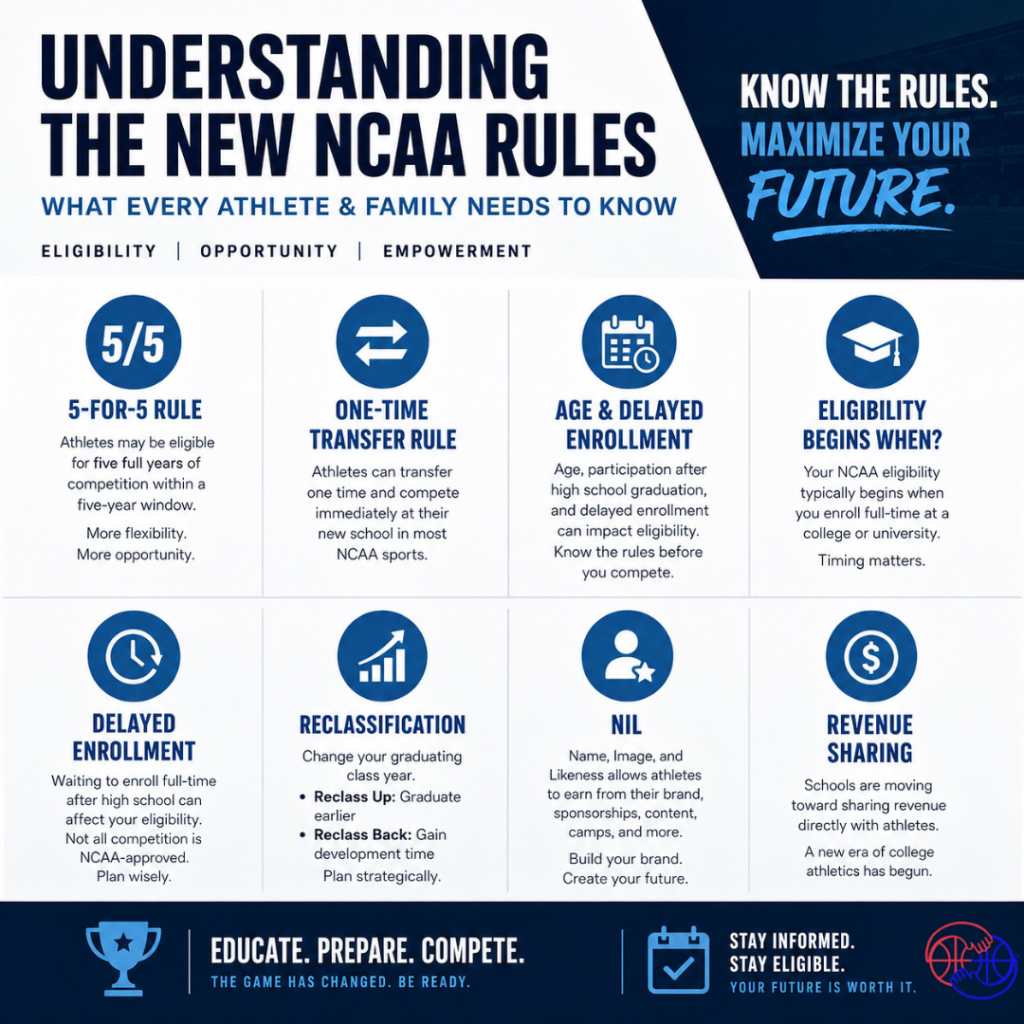
The landscape of college athletics is changing faster than ever. Between the NCAA’s proposed “5-for-5” eligibility model, the transfer portal, NIL opportunities, revenue sharing, reclassification, and enrollment rules, athletes and families are trying to navigate a completely different world than what existed even five years ago.
If you are a student-athlete, parent, coach, or recruiter, understanding these rules is critical because one decision can impact scholarships, eligibility, recruiting opportunities, and future earning potential.
Let’s break it all down.
⸻
What Is the NCAA “5-for-5” Rule?
The proposed NCAA “5-for-5” model is designed to simplify eligibility rules across college sports.
The idea is simple:
An athlete would receive five full years of eligibility to compete within a five-year window.
Traditionally, NCAA athletes had:
4 seasons of competition
Within a 5-year eligibility clock
The new “5-for-5” concept is attempting to create a cleaner system where athletes could potentially participate during all five years instead of losing seasons due to injuries, transfers, redshirts, or special circumstances.
This model is being discussed because:
Athletes are transferring more often
COVID eligibility changed the system
NIL opportunities have changed athlete decisions
The NCAA wants more flexibility and fairness
For many athletes, this could mean:
More time to develop physically
More opportunities to earn NIL money
More chances to graduate
More flexibility after injuries or transfers
⸻
What Is the One-Time Transfer Rule?
The NCAA transfer portal has completely changed college sports.
Under the current one-time transfer rule:
Student-athletes in most sports can transfer one time and become immediately eligible to compete at their new school.
In the past, transferring often meant:
Sitting out one full year
Losing development time
Falling behind academically and athletically
Now, athletes can:
Enter the transfer portal
Transfer schools once
Play immediately
However, after the first transfer:
Additional transfers may require waivers
Academic standards still matter
Schools may have conference-specific rules
This has created a new era where roster movement happens every offseason.
For athletes, the transfer portal can:
Create opportunities
Increase exposure
Help find a better fit
But it can also:
Create instability
Hurt long-term development
Lead to unrealistic expectations
The best transfers happen when athletes move for:
Better academic fit
Better coaching relationships
System/style fit
Genuine opportunity
Not simply because things became difficult.
⸻
Understanding NCAA Age Restrictions
One of the most misunderstood parts of NCAA eligibility is the age and delayed enrollment rule.
In many sports, especially international and elite developmental sports, the NCAA monitors:
Age
Participation after high school graduation
Delayed full-time enrollment
The NCAA generally starts evaluating eligibility once an athlete graduates high school.
For many Division I sports:
Competing after graduation before enrolling in college can impact eligibility
Playing organized competition may trigger penalties or use seasons of competition
This is especially important in:
Hockey
Tennis
Soccer
International basketball
Baseball
Athletes must be careful about:
Professional contracts
Playing with professionals
Receiving improper benefits
Delaying college enrollment too long
⸻
When Does NCAA Eligibility Begin?
A student-athlete’s NCAA eligibility clock typically begins when:
The athlete enrolls full-time at a college or university.
However, other activities before enrollment can still affect eligibility.
Important factors include:
High school graduation date
Organized competition after graduation
Gap years
Prep school attendance
International competition
Professional participation
This is why athletes should always verify their status with:
The NCAA Eligibility Center
Compliance departments
Trusted recruiting advisors
⸻
What Is Delayed Enrollment?
Delayed enrollment means:
An athlete waits to enroll full-time in college after graduating high school.
This can happen for many reasons:
Prep school
Injury recovery
International competition
Development leagues
Financial reasons
Academic preparation
The danger is that some competition during delayed enrollment can:
Reduce eligibility
Trigger NCAA penalties
Count as a season used
Athletes need to understand:
Not all competition is NCAA-approved
Amateurism rules still apply
Timing matters
One wrong decision can cost a season.
⸻
What Is Reclassification?
Reclassification is becoming extremely common in recruiting.
Reclassification means:
A student-athlete changes their graduating class year.
This can happen two ways:
Reclassifying Up
Graduating earlier than expected.
Example:
A 2027 athlete becomes a 2026 athlete
Reasons athletes reclassify up:
Academically advanced
Physically mature
Higher recruiting momentum
Earlier college opportunities
Reclassifying Back
Delaying graduation to gain development time.
Example:
A 2026 athlete becomes a 2027 athlete
Reasons athletes reclassify back:
Physical development
Athletic growth
Academic improvement
Recruiting exposure
⸻
How Do Athletes Reclassify?
The process usually involves:
Meeting academic credit requirements
Working with school counselors
Adjusting graduation plans
Updating recruiting profiles
Informing coaches and NCAA systems
Athletes should also:
Update NCAA Eligibility Center information
Update recruiting platforms
Communicate with college coaches
Reclassification can help an athlete tremendously — but only if done strategically.
⸻
What Is NIL?
NIL stands for:
Name, Image, and Likeness
NIL allows college athletes to make money from:
Social media
Sponsorships
Brand deals
Camps
Autographs
Merchandise
Appearances
Content creation
This completely changed college athletics.
Athletes are now brands.
Examples of NIL opportunities:
A basketball player promoting a local business
A football player signing autographs
A volleyball player monetizing TikTok
A soccer player hosting training camps
NIL earnings can range from:
Free meals and gear
Thousands of dollars
Millions for elite athletes
The key to NIL success is:
Building a personal brand
Growing social media presence
Creating value
Being marketable
Maintaining professionalism
Exposure matters more than ever.
⸻
What Is Revenue Sharing?
Revenue sharing is the next massive shift in college sports.
Traditionally:
Schools made millions
Athletes received scholarships only
Now, major conferences and schools are moving toward:
Sharing athletic revenue directly with athletes.
This means athletes may eventually receive:
Direct payments from schools
Compensation tied to media deals
Revenue distributions
This is expected to impact:
Recruiting
Scholarships
Roster building
Competitive balance
Revenue sharing could create a future where college athletics operates much more like professional sports.
⸻
Final Thoughts
College athletics is no longer just about talent.
Today’s athletes must understand:
Eligibility
Transfers
Branding
NIL
Enrollment timing
Reclassification
Academic standards
Long-term career planning
The athletes and families who educate themselves will have a massive advantage.
This new era rewards:
Awareness
Preparation
Strategy
Discipline
Adaptability
The game has changed.
The question is:
Are you prepared to navigate it the right way?