
AAU basketball has become one of the biggest parts of youth basketball culture, with families traveling across the country every spring and summer chasing tournaments, exposure, and the next opportunity.
But somewhere along the way, the message has gotten twisted — especially when it comes to what young players actually need to improve.
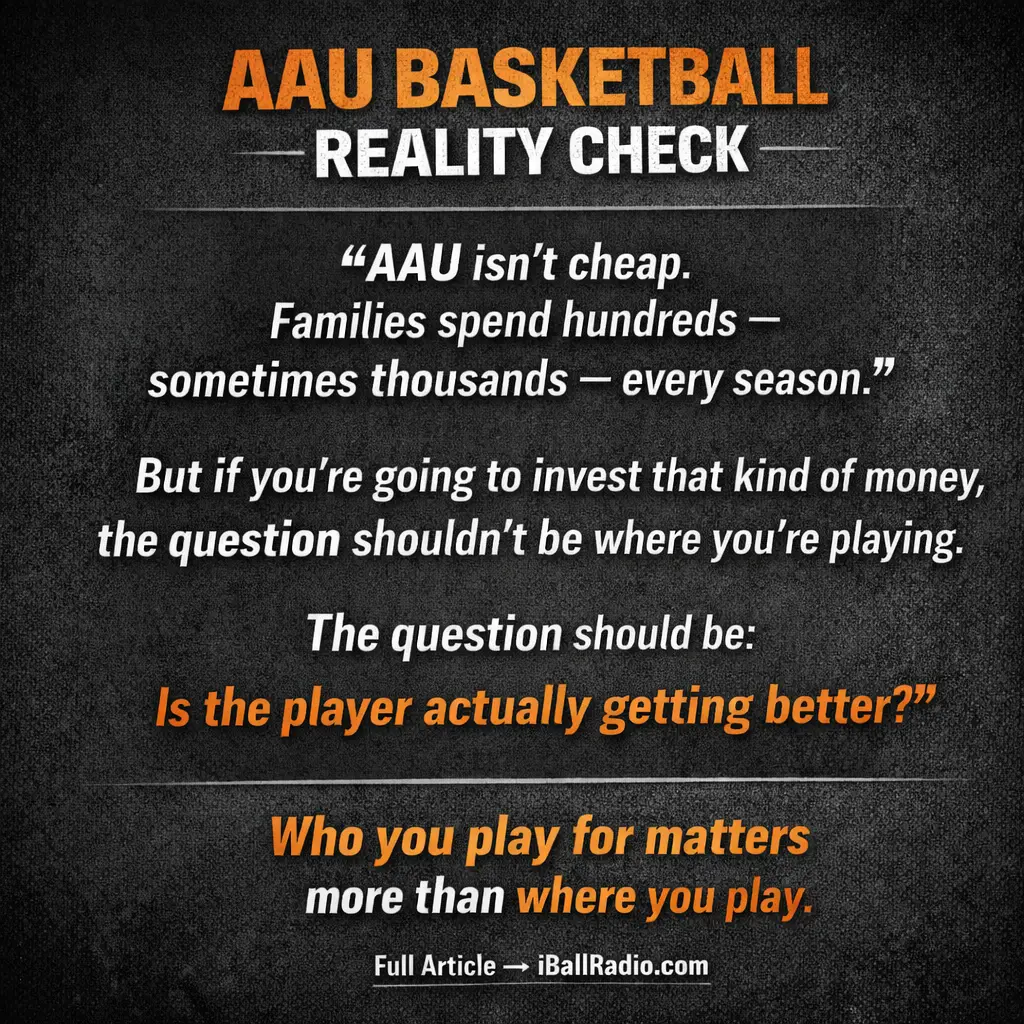
AAU basketball isn’t free, and it isn’t cheap — but if families are going to spend thousands chasing the game, the question shouldn’t be where you’re playing. The question should be whether the player is actually getting better.
Too many families believe they need to chase circuits, shoe teams, and national tournaments as early as possible. In reality, most players simply need development, structure, and coaching.
This article is meant for players and parents navigating AAU basketball from elementary school through high school. Understanding what actually matters at each stage can save families a lot of money, frustration, and wasted time.
AAU basketball can help a player grow — or it can become an expensive distraction depending on how it’s approached.
For players in 4th through 8th grade, the most important question in AAU basketball isn’t:
“What circuit are you on?”
The real question is:
Are you getting better?
At this stage players need:
The logo on the jersey, the tournament location, or the social media exposure simply doesn’t matter yet.
Not every team is the right team.
Many families jump to programs because they hear words like “circuit” or “shoe team” without asking whether the situation actually helps the player improve.
Ask the real questions:
If those things aren’t happening, the name of the program doesn’t matter.
One thing AAU does offer is the chance to compete against players from different cities and different levels of talent.
That competition can be extremely valuable when it’s paired with development.
Playing against strong competition should help players identify weaknesses and push them to improve.
Competition should expose areas that need work — not hide them.
AAU basketball should also help players learn the habits that make teams successful. Players should learn how to communicate with teammates, handle adversity, support the group, compete with effort, and understand how to function within a team concept. Those habits matter just as much as scoring points, and they often separate players who last in the game from those who don’t.
Exposure becomes more relevant during the 10th and 11th grade summer, which is the 16U and 17U AAU level.
That’s when players who truly have next‑level talent should start positioning themselves for opportunities where college programs are watching.
Before that stage, development should always be the priority.
One thing families need to understand from the start is that AAU basketball is expensive.
Between team fees, travel, hotels, food, tournament costs, and even entry fees for parents and fans, families can easily spend hundreds or even thousands of dollars during a spring and summer season. In many events, spectators are paying $20–$40 per person per day just to walk into the gym and watch the games.
That’s simply the reality of grassroots basketball.
The mistake many families make is believing that because they’re spending that kind of money, they should automatically be getting something in return like exposure, recognition, or attention.
That’s not how it works.
If you’re going to invest that kind of money, understand that part of what you’re paying for is the experience — the travel, the competition, the opportunity to play the game in different environments, and the memories that come with it.
That experience can be valuable.
But the most important return on that investment should still be development.
AAU basketball has slowly become more about presentation than development in some circles.
It’s easy to get caught up in things like:
But none of those things help a player improve.
AAU basketball was never supposed to be about gear or clout.
It’s supposed to be about getting better as a basketball player.
If the coaching is strong, the practices are structured, and the players are improving, then you’re in a good situation regardless of the name of the program or the tournament.
The most important factor in any AAU situation is who is coaching the players.
Good coaches will:
If the coaching isn’t strong, then the environment usually turns into nothing more than a collection of games instead of a place where players actually develop.
Playing 40, 50, or even 60 games in a summer doesn’t automatically make a player better.
Development comes from structured practice, skill development, repetition, and coaches who are actually teaching the game. Playing games has value, but games alone don’t build players. The practices, corrections, and teaching moments in between those games are where real improvement happens. Games should reinforce development — not replace it.
There’s also a reality that families need to understand about the modern AAU world. At every tournament there are a lot of people making money — tournament operators, event organizers, apparel companies, and program directors. Gyms are full, parents are paying $20–$40 a day just to get through the doors, and every weekend another event pops up promising exposure or a bigger stage. Meanwhile parents are covering travel, hotels, food, and team costs just to keep their kid in the game.
None of that is necessarily wrong — youth sports have always cost money. But families should recognize the difference between a basketball opportunity and a basketball business. The industry around AAU is massive, and sometimes the loudest voices selling the dream benefit more than the players themselves.
That’s why parents have to stay focused on the one thing that actually matters: Is the player developing? If the environment is teaching the game, building habits, and helping the player improve, then the investment makes sense. If not, families may just be paying to participate in the machine.
AAU basketball can be a powerful tool for development when it’s approached the right way. For most players, the early years should be about learning the game, developing skills, competing, and growing as a teammate. Families should understand that AAU is an investment — not just financially, but in time, travel, and commitment. Part of that investment is the experience of playing in different environments, meeting new teammates, and competing against different levels of talent.
But the most important return on that investment should always be development. The big circuits and national exposure matter later, when a player is actually ready for that level, typically during the later high school years. Until then, the focus should stay on good coaching, real teaching, and steady improvement. If those things are happening, then the player is on the right path — regardless of what logo is on the jersey or what tournament is on the schedule.