

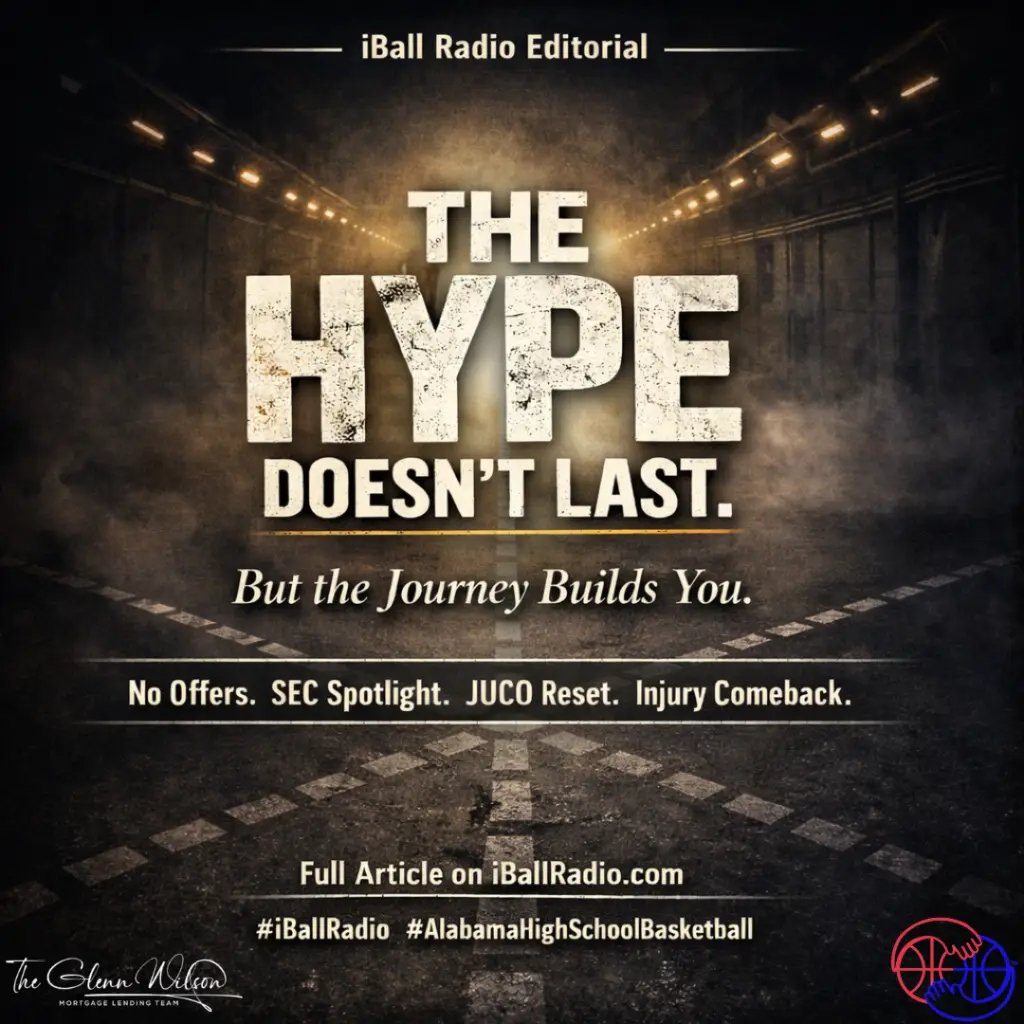
Let me say this clearly.
In today’s basketball culture, hype travels fast.
A breakout AAU weekend can generate offers. A commitment graphic can create buzz across social media. A ranking jump can shift how a player is viewed overnight.
But what rarely gets discussed is what happens after the noise fades.
And that’s the part you better understand if you’re serious about where you say you want to go.
Because for most players, the journey to where they ultimately want to be is anything but straight.
There are players from this state — now finishing college careers across the country — who have walked four very different versions of the same road: no offers, SEC spotlight, COVID detours, season-ending injury. None of them were linear.
That’s not coincidence.
That’s college basketball.
Greedy Williams’ story didn’t start with headlines.
Coming out of Montgomery and later Pinson Valley (2021) as a 6’2, maybe 6’3 point guard with size and feel, Williams had the physical tools college programs look for. What he didn’t have was momentum in the recruiting world. When his senior year ended, there were no Division I offers waiting.
No signing-day spotlight.
No late recruiting surge.
Just a decision.
Instead of settling or forcing the wrong opportunity, Williams chose the postgrad route at We Are United Prep in Nixa, Missouri — a move many players overlook because it doesn’t come with attention. It meant leaving home, betting on development, and trusting that another year would create another door.
That door opened at Northwestern State.
But the adjustment to Division I basketball wasn’t seamless. As a freshman, Williams played out of position and in a situation that didn’t fully maximize his strengths as a lead guard. The experience was valuable — but it wasn’t ideal.
That’s where the journey truly shifted.
After the coach took another job and no offer came from him at his next spot, and no real urgency from the new staff at NSU, Williams made another difficult decision: he transferred to Chipola College in Marianna, Florida — one of the premier JUCO programs in the country.
For some, JUCO is viewed as a setback.
For Williams, it was a reintroduction.
At Chipola, he returned to his natural position of point guard, took control of a team, and flourished. He won Panhandle Conference Player of the Year honors and emerged as a Top 10 JUCO recruit nationally. The production matched the potential.
The player who once had no offers was now one of the most sought-after junior college point guards in the country.
That resurgence led him to UNCW in the CAA.
Now in his second season at UNCW, Williams is widely regarded as one of the top point guards in the conference — a floor general with size (now 6’5), experience, and poise shaped by every stop along the way.
What makes Williams’ story stand out isn’t just where he is now — it’s how many times he had to recalibrate to get there.
Postgrad. Division I adjustment. JUCO dominance. Mid-major leadership.
Each chapter demanded something different.
And instead of chasing validation, he chased improvement.
Barry Dunning Jr., a 6’7 guard out of McGill-Toolen (2022), experienced the other side of the recruiting spectrum.
He signed with Arkansas, entering the SEC with national exposure and high expectations.
But college basketball has a way of humbling even the most promising recruits.
As a freshman at Arkansas, Dunning played in 16 games, making one start and averaging just 3.2 minutes per contest. The opportunity wasn’t what many envisioned when he signed.
He transferred to UAB, searching for a better fit. Injuries limited him to 15 games, and once again, consistency proved elusive.
Then came South Alabama.
In a system that allowed him to play freely and confidently, Dunning delivered a breakout season, averaging 15 points and 7 rebounds per game.
That production propelled him to Pitt in the ACC, where he is now logging nearly 30 minutes per game at one of college basketball’s highest levels.
Dunning’s path is a reminder that early exposure doesn’t guarantee early production.
The SEC spotlight didn’t define him.
The injuries didn’t derail him.
What ultimately mattered was finding the right environment to expand his game — and staying patient long enough to let that happen.
Antwan Burnett entered the 2020 recruiting cycle as one of the more physically imposing guards in the state — a 6’5 “manchild” at the position with multiple Division I offers during one of the most uncertain years in modern recruiting history.
In the heart of COVID, Burnett committed to Troy. On paper, it was momentum. A Division I opportunity. Stability during chaos.
But stability in recruiting does not always equal stability in development.
From Troy, Burnett transferred to Chipola College. He never suited up in a game there. The reset was incomplete.
Then came Shelton State Community College — another stop, another adjustment, another year proving himself.
Eventually, Burnett landed at Grambling State, where he spent two seasons continuing to refine his game, mature physically, and grow into his role at the Division I level.
This season, he finds himself at Missouri State, playing a major role and logging 26-plus minutes per night.
Burnett’s journey reflects the reality of the COVID class — uncertainty, movement, and constant proving.
Nothing about it was easy. Nothing about it was comfortable.
But seasons at Grambling and now meaningful minutes at Missouri State show what happens when talent is paired with persistence.
Cam Crawford, a 6’5 athlete out of Spain Park (2021), generated real buzz coming out of high school. He signed Division I with Indiana State, stepping into a program where opportunity seemed immediate.
His freshman season was up and down — flashes of athleticism, moments of impact, but still learning the pace and physicality of college basketball.
In Year 2, adversity hit hard.
An injury kept him out the entire season.
For many players, that kind of setback stalls momentum beyond repair.
Crawford transferred to Marshall, searching for another opportunity to regain rhythm. The season didn’t come with major fanfare or national attention. It also was not the right fit.
Then came Duquesne in the Atlantic 10.
In his second year there, Crawford has carved out a defined niche and is playing meaningful minutes at the major college level.
Crawford’s story isn’t about a single breakout moment.
It’s about resilience.
An injury year. A transfer. Another transfer. A search for fit.
And now, in the Atlantic 10, a role carved out through patience rather than noise.
So here’s the part I need young players — and parents — to hear.
For every player whose career follows a straight line from high school to high-major stardom, dozens more travel a winding road.
Some go from high school to postgrad.
Some detour through JUCO.
Some transfer once. Some transfer twice.
Some battle injuries before finding rhythm.
None of those moves automatically define failure.
In many cases, they define growth.
Greedy had to reset his entire recruiting trajectory.
Dunning had to survive the lack of early minutes that didn’t match the hype.
Burnett had to navigate the uncertainty of the COVID class.
Crawford had to sit out an entire season and rebuild.
Different circumstances.
Same demand: adjust.
What hype often overlooks is the importance of fit — the right system, the right role, the right coaching staff, and the right developmental environment.
A scholarship offer is not the finish line.
A commitment graphic is not the destination.
An early ranking does not guarantee longevity.
If your identity is built on applause, you won’t survive adversity.
Sustained success requires adaptability, humility, and the willingness to reroute when necessary.
The basketball world remembers the headlines.
But players live the chapters in between.
Montgomery to Missouri to Louisiana to Florida to North Carolina.
Mobile to Fayetteville to Birmingham to Mobile to Pittsburgh.
Four stories. Different paths. Same principle.
The hype may introduce you.
But the journey determines who you become.
The hype doesn’t last.
Great players — the ones willing to adjust, endure, and keep building — do.